



Space-based life support innovations offer a vital blueprint for resource independence both in Low Earth Orbit and across Earth's most water-scarce regions.
Introduction
Standing inside a pristine research facility, a team of life support engineers watches a single drop of purified water drip into a collection vessel. The liquid did not originate from a local aquifer—it began hours earlier as highly concentrated metabolic waste, processed through a system designed to keep humans alive in space (Sowmeya & Sathiavelu, 2025). In microgravity, where transporting resupply mass into orbit costs between $10,000 and $20,000 per kilogram (Ichimura & Yamashiki, 2025), water cannot be treated as a disposable commodity (Sowmeya & Sathiavelu, 2025).
As public space agencies and commercial ventures prepare for continuous human habitation in Low Earth Orbit (LEO) (Sowmeya & Sathiavelu, 2025), life support systems must evolve beyond traditional mechanically bound recovery loops (Sowmeya & Sathiavelu, 2025). Transitioning from mechanical distillation to bio-regenerative hybrid architectures represents an essential step forward for human spaceflight and off-grid terrestrial water security (Sowmeya & Sathiavelu, 2025; Ichimura & Yamashiki, 2025).
This article represents a CONOPS (Concept of Operations) to the closed-loop wastewater treatment system on board of low orbit spacecrafts.
Thesis
There are only chemical and physical treatment of wastewater onboard spacecrafts which gives 98% water recovery. By integrating biological membrane systems and plant transpiration zones with proven International Space Station (ISS)-heritage mechanical, hybrid life support architectures can push water recovery efficiency beyond 98.5%, extend system lifespans (Ichimura & Yamashiki, 2025), and eliminate reliance on heavy terrestrial resupply logistics (Sowmeya & Sathiavelu, 2025; Stromgren et al., 2017). The problem is that biological treatment happens through bacteria and bacteria’s behavior is not predicted in space.
Main Argument: Overcoming the Physical Limits of Mechanical Distillation
For over two decades, crewed orbital platforms have relied on physical-chemical processes - specifically Vacuum Compression Distillation (VCD) - to harvest clean water from cabin humidity and urine (Sowmeya & Sathiavelu, 2025; Stockman et al., 2007). While modern configurations achieve an impressive 98.0% water recovery rate (Sowmeya & Sathiavelu, 2025; Muirhead et al., 2023), mechanical systems hit a sharp thermodynamic wall when handling high mineral concentrations (Sowmeya & Sathiavelu, 2025; NASA, 2024). Urea and nitrogenous compounds in human waste cause aggressive calcium sulfate precipitation when boiled down (Sowmeya & Sathiavelu, 2025; Muirhead et al., 2023), scaling mechanical evaporators (Ichimura & Yamashiki, 2025; NASA, 2024) and requiring chemical pre-treatments to prevent microbial line bio-fouling (Sowmeya & Sathiavelu, 2025). Integrating a biological secondary loop changes these chemical boundaries (Sowmeya & Sathiavelu, 2025). A biological Membrane Bioreactor (MBR) utilizes active microbial cultures to metabolize urea into stable nitrates (Sowmeya & Sathiavelu, 2025). Shifting nitrogenous waste processing to biological media prevents downstream mineral precipitation (Sowmeya & Sathiavelu, 2025), extending mechanical assembly lifespans from 3 years to over a decade (Ichimura & Yamashiki, 2025).
The 10-Year Economic & Trade-Off Analysis
Adding a biological secondary loop avoids mechanical evaporator scaling beyond 10,000 operational hours (NASA, 2024), extending VCD hardware lifespan from 3 years to over 10 years (Ichimura & Yamashiki, 2025). Economically, capturing an additional 0.5% of water recovery saves over 180 kg of resupply mass per 180-day rotation (Stromgren et al., 2017), yielding $3.6M to $7.2M in annual launch cost savings per module (assuming $10,000–$20,000/kg launch cost) (Ichimura & Yamashiki, 2025; Wu et al., 2024).
The Specialized Role of Aeroponics in Water Recovery
Within the hybrid secondary loop, the aeroponic crop growth module plays a direct functional role in extracting clean liquid water (Sowmeya & Sathiavelu, 2025):
- Metabolic Conversion & Root Absorption: Once wastewater is pre-treated by the MBR, the nutrient-rich fluid is misted directly onto plant roots suspended in air (Sowmeya & Sathiavelu, 2025).
- Biological Transpiration: The plants absorb the liquid, naturally filtering out remaining micro-contaminants through root membranes and transpiring the final 0.5% of clean water mass into cabin air as pure water vapor (Sowmeya & Sathiavelu, 2025).
- Atmospheric Harvesting: Cabin condensing heat exchangers immediately harvest this atmospheric vapor, converting plant sweat into high-purity drinking water and pushing total station recovery efficiency to > =98.5% (Sowmeya & Sathiavelu, 2025; Muirhead et al., 2023).
Case Study: The Low Earth Orbit Bio-Regenerative Hybrid (LBP-WRS)
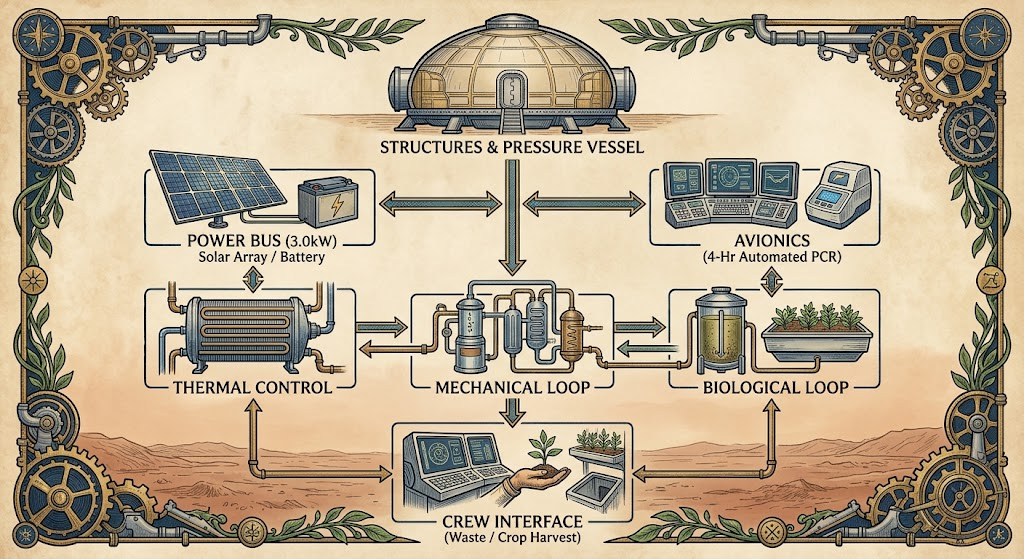
The Low Earth Orbit Bio-Regenerative and Physical-Chemical Hybrid Water Reclamation System (LBP-WRS) was conceptualized as a modular payload operating on commercial LEO stations (Sowmeya & Sathiavelu, 2025; Esper, 2004). Engineered for a crew of four to six over 180-day mission blocks (Sowmeya & Sathiavelu, 2025; Larson & Pranke, 1999), the payload pairs a high-heat mechanical distillation assembly with an aeroponic crop growth module (Sowmeya & Sathiavelu, 2025) (Table 1, Figure 1).
| System Constraint / Metric | Target Performance Value | System Engineering Traceability | Primary Functional Purpose |
|---|---|---|---|
| Water Recovery Rate | >= 98.5% | Larson & Pranke (1999); Wu et al. (2024) | Eliminates recurring mass resupply needs (Sowmeya & Sathiavelu, 2025) |
| Operational Availability | 98.0% | NASA Systems Engineering Handbook (2016) | Ensures continuous life support redundancy (Sowmeya & Sathiavelu, 2025) |
| Diagnostic Latency | < 4 hours | NASA STD-3001 | Prevents microgravity biofilm formation (Sowmeya & Sathiavelu, 2025) |
| Power Consumption Cap | < 3.0 kW peak draw | Commercial LEO Bus Specifications | Fits standard station power buses (Sowmeya & Sathiavelu, 2025) |
Concept of Operations (CONOPS) Phase Breakdown & The Year 4 Lifecycle Gate
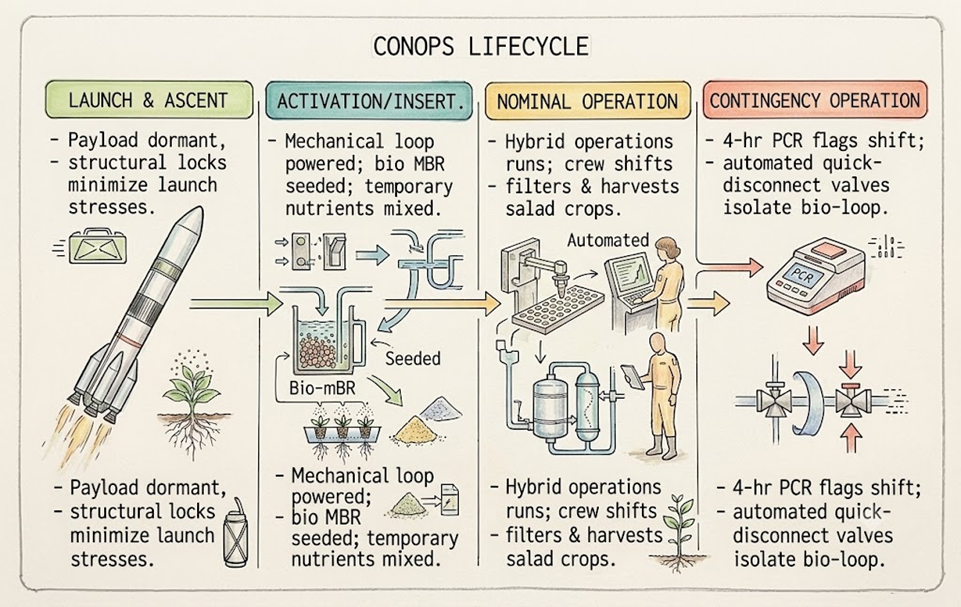
The system's CONOPS progresses through four operational phases (Esper, 2004; NASA, 2016) (Figure 2):
- Launch/Ascent: Dormant payload secured with structural locks to minimize stresses (Esper, 2004).
- Activation/Insertion: VCD powers up to build reserves while MBR is seeded with temporary nutrient mixes (NASA, 2024).
- Nominal Operations: Hybrid dual-path processing running continuously, yielding water and salad crops (Sowmeya & Sathiavelu, 2025).
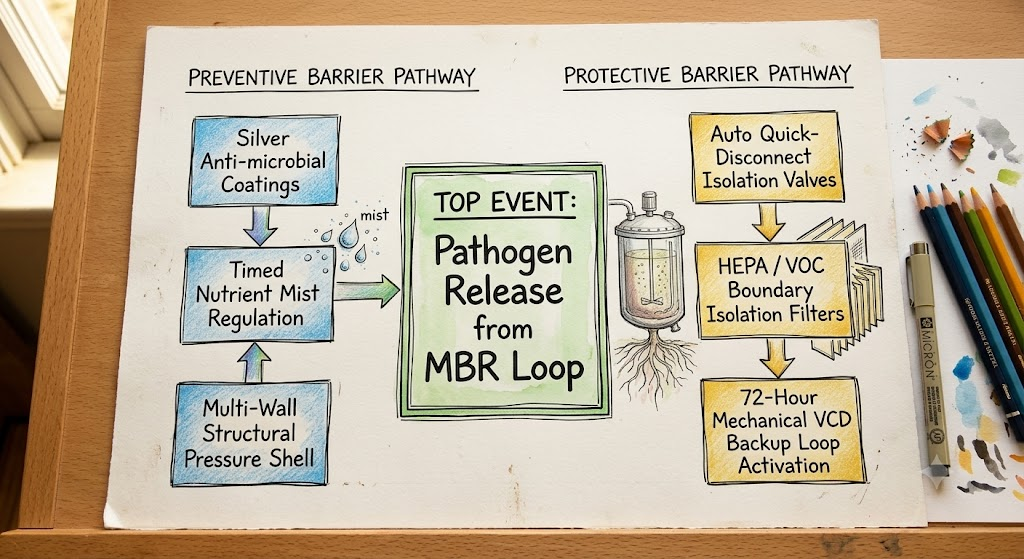
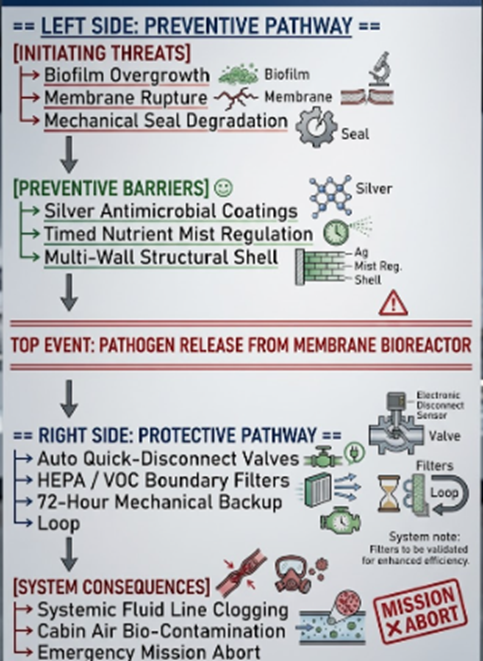
- Contingency Operations: A 4-hour microfluidic PCR suite detects pathogen shifts and triggers quick-disconnect valves to isolate the bio-loop within <1 second (Childress et al., 2023; NASA, 2016b; ECSS, 2010).
Human Systems Integration (HSI) & Fail-Safe Controls
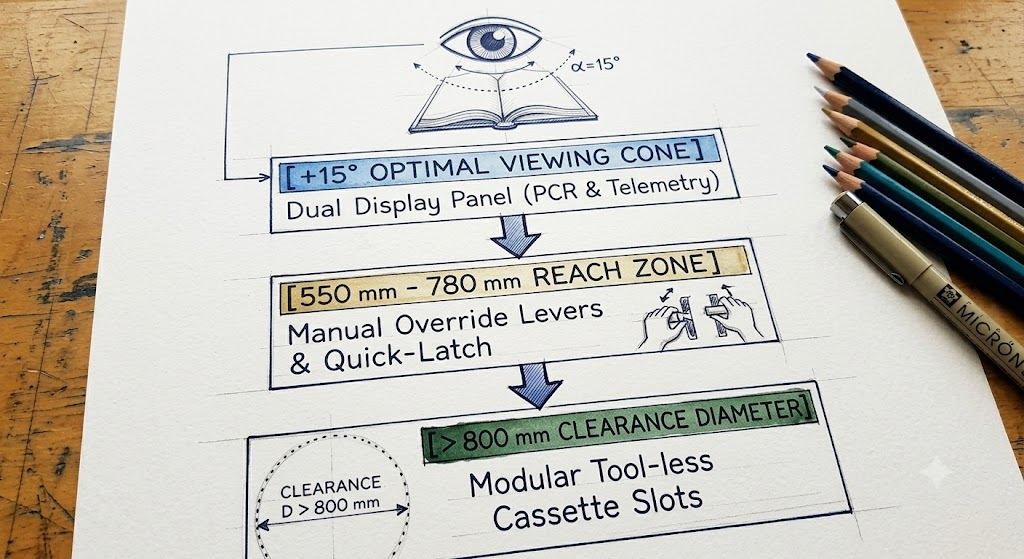
Operating biological hardware in microgravity requires strict hazard control and ergonomic engineering (Figures 3 and 4):
- Visual Field Alignment: Critical status displays, biological alarms, and system metrics sit strictly within the astronaut's central plus/ minus 15 degrees optimal viewing cone to minimize visual scanning delays during high-stress operational events (Childress et al., 2023; Sowmeya & Sathiavelu, 2025; Ichimura & Yamashiki, 2025; NASA, 2014).
- Postural Reach Envelope: All physical interface components, valves, and service access panels are designed to sit within the 5th-to-95th percentile astronaut neutral body posture reach zone (550 mm to 780 mm forward reach) (Childress et al., 2023; Sowmeya & Sathiavelu, 2025; Ichimura & Yamashiki, 2025; NASA, 2014).
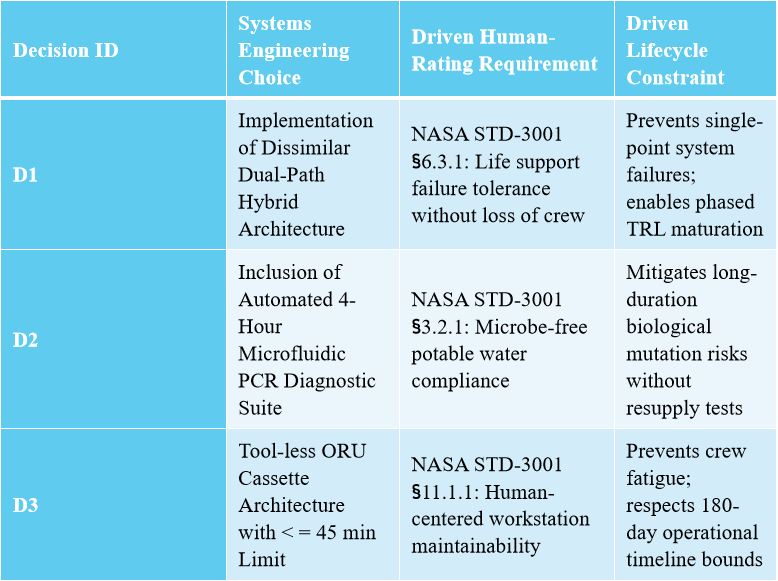
- Automated vs. Manual Isolation: An automated microfluidic PCR suite monitors microflora every 4 hours (Sowmeya & Sathiavelu, 2025; NASA, 2016b). If pathogens or anomalous bacterial shifts are detected, software triggers quick-disconnect valves to seal the biological loop (ECSS, 2010; Sowmeya & Sathiavelu, 2025; Ichimura & Yamashiki, 2025).
- Manual Override Redundancy: If automated interlocks fail or the primary system fails to shut down, physical manual shut-off levers are built directly into the front access panel (Childress et al., 2023; Ichimura & Yamashiki, 2025; Silva-Martínez et al., 2023). Astronauts can manually isolate the biological loop and force a 100% fluid bypass into the mechanical distillation system (Sowmeya & Sathiavelu, 2025; Ichimura & Yamashiki, 2025; Jones, 2015).
Actionable Takeaways & Programmatic Phasing
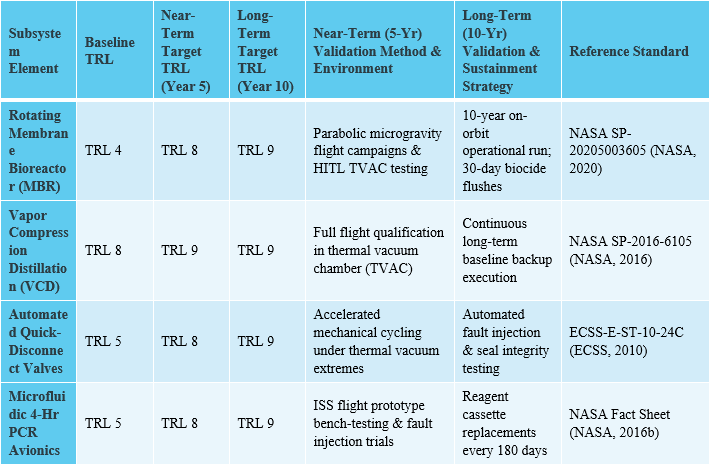
Deploying hybrid bio-regenerative systems requires balancing performance gains against technical and operational risks (Sowmeya & Sathiavelu, 2025; Ichimura & Yamashiki, 2025; Stromgren et al., 2017) (Tables 2 and 3):
- Dual-Path Redundancy: Hybrid systems must retain a 100% capable physical-chemical backup to prevent catastrophic life support failure if biological cultures degrade (Sowmeya & Sathiavelu, 2025; Jones, 2015).
- Year 4 Flight Gate: Biological modules undergo parabolic flight testing in Year 4 to validate multi-phase fluid control (Sowmeya & Sathiavelu, 20255; Ichimura & Yamashiki, 2025; NASA, 2020). If microgravity fluid criteria are missed, the biological payload is decoupled, and the platform reverts to the Technology Readiness Level (TRL) 9 mechanical baseline without delaying launch timelines (Sowmeya & Sathiavelu, 2025; Ichimura & Yamashiki, 2025; NASA, 2020).
- Terrestrial Cross-Pollination: Technologies developed to process space brine offer low-power solutions for decentralized, solar-powered water purifiers in drought-prone hyper-arid zones on Earth (Sowmeya & Sathiavelu, 2025; Ichimura & Yamashiki, 2025; Wu et al., 2024).
Conclusion
Revisiting that single drop of purified water in the laboratory, its significance extends far beyond the physical boundaries of an orbiting station (Sowmeya & Sathiavelu, 2025; Ichimura & Yamashiki, 2025). Capturing the final fractions of wastewater efficiency is not just an orbital exercise in launch mass reduction; it is a fundamental shift toward circular resource stewardship (Sowmeya & Sathiavelu, 2025; Ichimura & Yamashiki, 2025).
By coupling the operational reliability of mechanical engineering with the self-sustaining performance of aeroponics and bioreactors (Sowmeya & Sathiavelu, 2025), hybrid reclamation architectures establish the foundation for permanent human presence in space while offering vital technical lessons for water security here on Earth (Sowmeya & Sathiavelu, 2025; Ichimura & Yamashiki, 2025).
Glossary
- Aeroponics: A soil-free cultivation technique where plant roots are suspended in air and periodically misted with nutrient-dense water solutions (Sowmeya & Sathiavelu, 2025).
- Membrane Bioreactor (MBR): An advanced filtration unit combining biological microflora treatment with physical membrane separation to break down complex organic waste (Sowmeya & Sathiavelu, 2025).
- Technology Readiness Level (TRL): A standardized measurement system used to assess technology maturity, ranging from TRL 1 (basic principles) to TRL 9 (flight-proven in operational missions) (Sowmeya & Sathiavelu, 2025; NASA, 2020).

Childress, S. D., Williams, T. C., & Francisco, D. R. 2023. NASA Space Flight Human-System Standard: Enabling human spaceflight missions by supporting astronaut health, safety, and performance. npj Microgravity, 9(1), 1–12. https://doi.org/10.1038/s41526-023-00275-2
European Cooperation for Space Standardization. 2010. Space engineering: Interface management (ECSS-E-ST-10-24C Rev. 1). ECSS Executive Secretariat.
Esper, J. 2004. Modular, adaptive, reconfigurable system (MARS): Technology for sustainable, reliable, effective, and affordable space exploration. NASA Goddard Space Flight Center. https://ntrs.nasa.gov/api/citations/20050071087/downloads/20050071087.pdf
Ichimura, S., & Yamashiki, Y. A. 2025. Assessment of the physical and psychological aspects of the current life support system on the International Space Station for sustainable space exploration. Frontiers in Space Technologies, 5, Article 1461389. https://doi.org/10.3389/frspt.2024.1461389
Jones, H. W. 2015. Diverse redundant systems for reliable space life support (Paper No. ICES-2015-32). 45th International Conference on Environmental Systems, Bellevue, Washington. https://ntrs.nasa.gov/api/citations/20160001252/downloads/20160001252.pdf
Larson, W. J., & Pranke, L. K. (Eds.). 1999. Human spaceflight: Mission analysis and design. McGraw-Hill.
Muirhead, D., Carter, D. L., Thomas, F., & Williamson, J. 2023. 2023–2024 Status of the Brine Processor Assembly (Paper No. ICES-2023-097). 52nd International Conference on Environmental Systems, St. Paul, MN. https://ttu-ir.tdl.org/bitstreams/774483a2-def4-4d9f-a9ce-007cc83d0799/download
National Aeronautics and Space Administration. 2014. Human integration design handbook (NASA/SP-2010-3407 Rev 1). NASA Headquarters.
National Aeronautics and Space Administration. 2016. NASA systems engineering handbook (NASA/SP-2016-6105 Rev 2). NASA Headquarters. https://www.nasa.gov/wp-content/uploads/2018/09/nasa_systems_engineering_handbook_0.pdf
National Aeronautics and Space Administration. 2016b. WetLab-2: Real-time quantitative PCR tools for the International Space Station (Fact Sheet). NASA Ames Research Center. https://www.nasa.gov/wp-content/uploads/2016/03/wetlab2-fs-26oct15.pdf
National Aeronautics and Space Administration. 2020. Technology Readiness Assessment: Best Practices Guide (NASA/SP-2020-6122). NASA Headquarters.
National Aeronautics and Space Administration. 2024. Advanced Environmental Control and Life Support Systems for deep space exploration: 2024 technology roadmap (Tech Report No. MSFC-ECLSS-2024). NASA Marshall Space Flight Center.
Silva-Martínez, J. J., Etchells, M., & Bradshaw, T. 2023. Implementation of human systems integration technical processes in the Gateway program. Acta Astronautica, 207, 200–205. https://doi.org/10.1016/j.actaastro.2023.03.018
Sowmeya, V. G., & Sathiavelu, M. 2025. Biofilm dynamics in space and their potential for sustainable space exploration: A comprehensive review. Life Sciences in Space Research, 44, 108–121. https://doi.org/10.1016/j.lssr.2024.08.006.
Stockman, W., Boyle, J., & Bacon, J. 2007. International Space Station systems engineering case study (NASA/TP-2007-214771). National Aeronautics and Space Administration. https://www.nasa.gov/wp-content/uploads/2015/05/design_iss_systems_engineering_case_study.pdf
Stromgren, C., Goodliff, K. E., Cirillo, W., Owens, A. C., & De Weck, O. L. 2017. Supportability challenges, metrics, and key decisions for future human spaceflight. AIAA SPACE Forum. https://hdl.handle.net/1721.1/115081
Wu, W., Shen, J., Kong, H., Yang, Y., Ren, E., Liu, Z., Wang, W., ... & Xiong, R. 2024. Energy system and resource utilization in space: A state-of-the-art review. The Innovation Energy, 1(1), Article 100029. https://doi.org/10.59717/j.xinn-energy.2024.100029