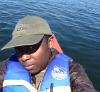

Interview with Dr. Christopher Ilori
Christopher Ilori is a remote sensing scientist with over a decade of experience applying satellite data to water resources, coastal environments, and conservation challenges. His work sits at the intersection of physics-based remote sensing, geospatial analysis, and capacity building. Trained as a geographer with a PhD in Remote Sensing, his research focuses on understanding how light interacts with the atmosphere and water column to retrieve meaningful environmental information from space.
Currently a Senior Remote Sensing Specialist at TCarta, Christopher leads and supports large-scale satellite-derived bathymetry (SDB) projects for navigation safety, environmental monitoring, and coastal management. His work combines radiative transfer theory, image preprocessing, and applied machine learning to derive water depth and water-column properties in optically complex environments. Beyond industry, he has contributed to international initiatives including the United Nations Office for Outer Space Affairs (UNOOSA), where he supports best practices for applying Earth observation data to water resources management.
Christopher is passionate about teaching and capacity building. He has taught and mentored students at the post-secondary level and regularly trains professionals in satellite data preprocessing, atmospheric correction, and water-focused remote sensing workflows. He believes that understanding physical principles – rather than relying solely on black-box tools – is essential for the responsible use of space technologies.
Through his involvement with Space4Water, Christopher advocates for accessible, practical guidance that helps practitioners and decision-makers use satellite data effectively, particularly in data-limited regions and Small Island Developing States (SIDS). He emphasizes that while satellite data availability has increased dramatically, gaps remain in awareness, training, and integration with local knowledge. Addressing these gaps, he argues, is key to ensuring space technologies genuinely support sustainable water management.